Armenians have lived in the region of Artsakh (Nagorno‑Karabakh) for thousands of years. During the Soviet era, Joseph Stalin placed Artsakh within the borders of Azerbaijan along with many other geographies that sparked wars and conflicts later in the 20th century. After the collapse of the Soviet Union, Artsakh declared independence and, through multiple conflicts, maintained self‑governance. For 30 years, it operated with a democratically elected government and met the key criteria for statehood.
In 2020, Azerbaijan won a 44‑day war that forced Artsakh to relinquish more than half of its territory.
The tragedy did not end here. In December 2022, in violation of the existing peace agreement, Azerbaijan blocked the sole road, Lachin Corridor, connecting Artsakh to Armenia. For more than nine months, the 120,000 people of Artsakh endured severe shortages of food, medicine, fuel, and essential supplies. They, however, persevered.
The last offensive by Azerbaijan was the last two months of the blockade, when even the International Red Cross was prevented from delivering aid or evacuating the sick.
On September 19, 2023, Azerbaijan launched a military offensive against Artsakh. Numerous international observers and human rights organizations have reported missile strikes on civilian areas, mass displacement, and widespread abuses. Artsakh ultimately had no choice but to dissolve its government, defense forces, and territorial claims.
Today, tens of thousands of Armenians have fled their homes — leaving behind their property, livelihoods, cultural heritage, and the graves of their ancestors — in order to escape violence and persecution.
------------------------------------------------------------------------------------------------------------------------------------------
For two consecutive years, St. Sarkis serves as the proud host of the Genocide Education Summit for Texas Teachers.
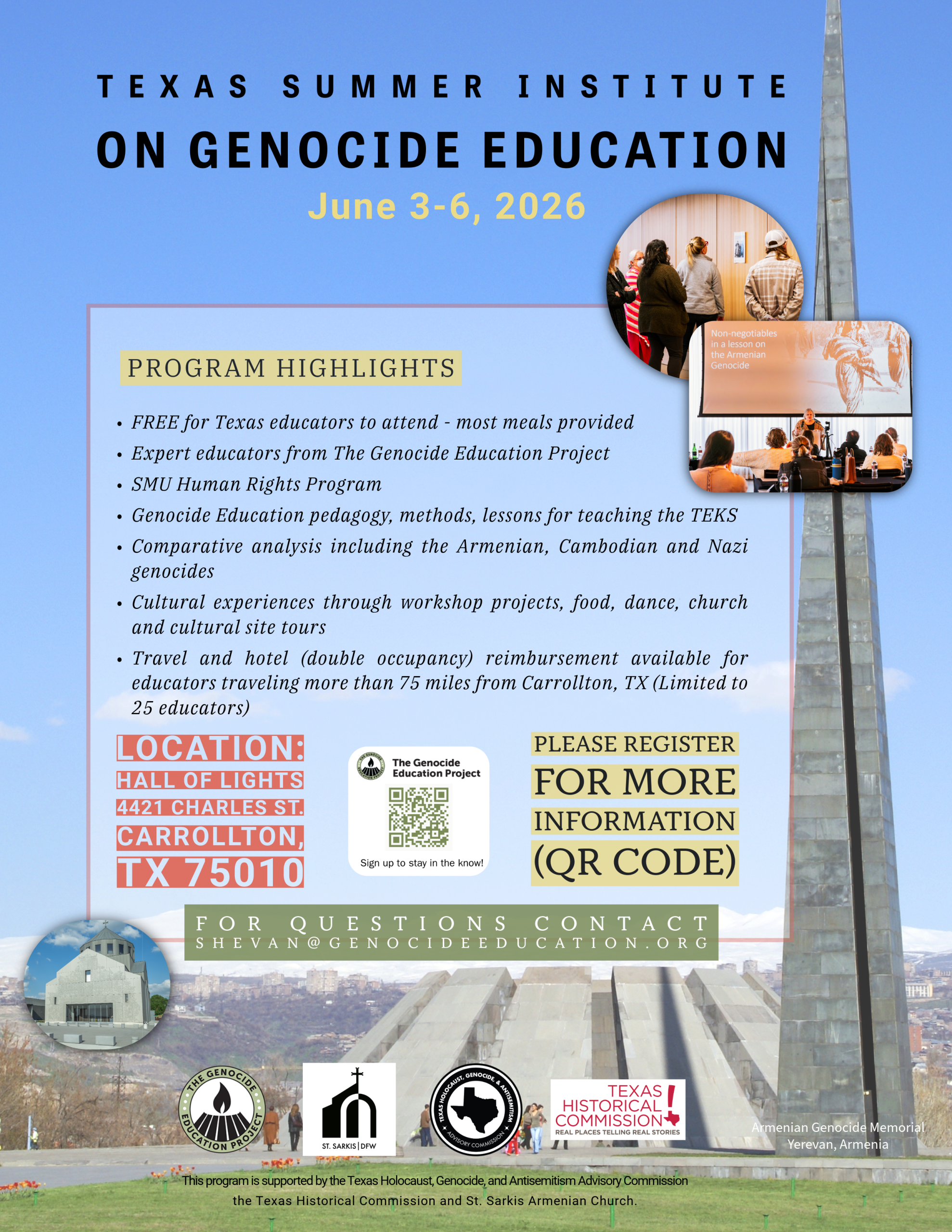
Join us on June 3-6, 2026 for a FREE Texas Summer Institute on Genocide Education. The 3-day program will provide an exceptional professional learning opportunity that will equip teachers to confidently teach World History TEKS pertaining to genocide. Using comparative analysis of genocide against the Armenians, Cambodians, and the Nazi genocide as case studies, learn about the best practices, lesson plans and tools to teach genocide.
Held at the Hall of Lights in Carrollton, TX (next to Hebron High School), the institute will include professional educators from The Genocide Education Project, Southern Methodist University Human Rights Program and Armenian and Cambodian community members.
The summer institute is open to any secondary (grades 6-12) Social Studies or English Language Arts educators in the state of Texas and will provide professional development credit. Travel reimbursement and hotel accommodation (double occupancy) is available for educators traveling more than 75 miles from Carrollton (limited to 25 educators).
Schedule:
Wednesday, June 3 - Evening Welcome Reception at the beautiful Hall of Lights in Carrollton TX.
Thursday, June 4 - Full day workshop - pedagogy, methods, lessons, genocide survivor speakers (Evening free to explore Dallas).
Friday, June 5 - Morning workshop, afternoon cultural tour, Armenian "Kef" night - experience a fun night of Armenian culture, music, food and dance!
Saturday, June 6 - Half Day workshop - classroom applications, breakout sessions.
The Texas Summer Institute on Genocide Education will include:
Applications are accepted through February 15, 2026. Please APPLY HERE.
We look forward to you joining us for an exceptional professional development program.